Well, I picked up my new (old) boat from Fort William last weekend. An Island Kayaks Expedition. Took it for my maiden voyage in it in FW - great boat, high volume, nice for turning on an edge. It's had a knock here and there, so when I got home I did my first fibre glass fixing...
INSERT PIC 1 - BEFORE
INSERT PIC 2 - AFTER
I had thought making a fibre glass fixing was going to be hard, but it wasn't really. I think the most important thing was just taking time over it.
Tuesday, February 26, 2008
New (second hand) boat, and fibreglass reinforcing...


Friday, February 08, 2008
Coaching Toolbox
I just made this up (see below) because I wanted one bit of paper which illustrated pretty much all the coaching tools/techniques that I use. It's useful as a reminder, and everything on it allows me to psychologically deal with pretty much any situation.
Off surf kayaking tomorrow, and just bought my first ever camera, which happens to be waterproof - finally, I can take pictureson the water and not have to worry about killing my camera!
Saturday, January 26, 2008
Plannning and Risk Assessment
Planning and Risk Assessment

I’ve been thinking about decision making in relation to kayaking. Trying to figure out, if I have a group, what questions I should ask myself about the situation, and what order I should do things in. I like having rules for approaching things because it makes that approach simpler. I was also thinking about the minimum things that I would want to know about a group and a trip that we were going to do, and then other things beyond the minimum that I’d like to know. What I’ve come up with is this:
For any kayaking session, the first thing I want to know is my group’s experience. From that, the second thing that we will do is come up with a plan for what we’re going to do, i.e. goals. The third thing that follows on is a risk assessment for that plan or those goals. These three things are all already defined for things that are completely standard, however for other things (for example expeditions), they change here and there, so we have to adapt and be flexible. I like to categorise them in to generic (things that could happen anywhere) and specific (which are the varying components of the risk assessment).
I then thought that pretty much all our activity, whether it’s kayaking, or sitting at a computer, has goals that we want to achieve, whether that’s typing a letter, or watching the sun go down. And a risk assessment can be done for any of those goals. In my formal risk assessment, I write preventative and reactive action, in relation to a risk.
So, to cut a long story short, after formalising the process in my head, I now feel like I can approach any situation, automatically carrying out a risk assessment, and dynamically assessing the risk as the situation flows.
Looking forward to a bit of surf kayaking this weekend, as the F9 gale blowing outside whips up some swell…
Tuesday, January 22, 2008
Sun, Surf, and Solitude (and fire lighting)
 I needed to get away for a camping trip to keep my skills up to date, and find out if I was capable of paddling around happily on my own for the expedition in May. A quick bit of packing, check of the pilot for tidal stream times, check of HW times, and weather forecasts, and the planning was complete. F6-7, gusting 8 - great! It had been blowing Westerly for a few days, so no doubt, a bit of swell. Off I went from Castlebay, not exactly sure where I would go, maybe Mingulay, maybe Pabbay, maybe Sandray, it was getting late - and I still had to find firewood and get a fire lit to cook dinner - so probably just Sandray!
After a few hours paddling, I rounded the headland and was confronted with a beach with a wee bit of foam, and a bit of surf landing was required. I counted the sets, and the period, found my moment, and went for it! It was all going well, until I felt/saw something rearing up behind me, luckily it wasn’t huge, so I ended up side surfing in the right way up. Having not approached many beaches recently that I did not set out from, I was reminded how difficult it is to judge the size of waves from the sea side rather than the beach. When I got ashore, I was a little disappointed at what I had pumped so much adrenalin around my body for!
 So after my heart had calmed down, I got on to collecting and chopping firewood, finding a campsite. The axe and machete (brought the latter because I lost my knife surfing a few weeks ago) were invaluable in making tinder, kindling, and graded fuel for the fire. I had taken some of my own drier wood, and some tinder that had been dried on a metal plate on the stove at home. To cut a long story short, I couldn’t get it lit just using toilet roll and my tinder, so I had to result to petrol from my stove! Mental note: practice fire lighting! But hey, in the end I got it going, and practiced using different structures for fires. I now like the one below, using a wedge shape of thick wood which doesn’t burn too quickly, to give a structure that you can either put a pot on top of, or a wooden matrix to dry it out, the latter of which gives you simmer control for cooking - fantastic. 30mins later I was munching on pasta with pesto sauce, with fried onion and tomato.
 After dinner, the solitude got to me a bit. Being alone on another island was a bit lonely at first. Eventually I resorted to talking to myself, which was surprisingly comforting, and as the evening went on, I listened to the MP3s on my phone. I had forgotten that I didn’t have credit on my sim card, so had to wait up on the hill (where I had a signal) for 2 hours for the phone call at 9pm from my folks, which I said I would make at 8pm. I was glad they phoned, because I wouldn’t have been able to sleep if I was half expecting the lifeboat to come round the corner in the middle of the night. It was a long night.
I woke up cold, thinking the waves sounded really big. Thankfully, when I got up, they were much smaller than they sounded! I had my porridge/raisin mix that been left soaking the night before, packed up, and to my horror, watched the waves getting bigger! The tide was nearing low water, and it was starting to dump. To cut a long story short, it took me 20mins to get out, after rescuing a lunch box and set of splits! But finally I made it, “woo hoo!”
 I knew the swell round the west coast of Sandray was going to be awesome - I had to do it! I couldn’t resist seeing what the sea was like. The swell was indeed awesome! Scary at first, the power of it and what it could to do someone if they were in the wrong place at the wrong time felt surreal, so I kept my distance from the rocks. No photos as all I had was my phone for pictures. Progress was slow into the wind, and bouncing around in the clapotis. Out of the clapotis, it wasn’t too bad. The long rolling swell passed underneath me. Sometimes in the trough, I’m sure the swell must have been 12-15ft at times. Intimidating at first, but it was surprising how I got used to it.
So that was the exciting part. I decided against going up the W coast of Barra to get home to Northbay, into the wind and swell, and went back to Castlebay, using the east going stream. 3 hours paddling - I can’t wait till I get my own boat, so I can kit it out so that it’s comfy!
Learning experiences:
1) Always remember the IKEA bag!
2) Always make sure you’ve got credit and more than one sim card;
3) Big swell isn’t that bad when there’s nothing in its way!
4) I need to practice fire lighting with tinder;
5) When I get my own boat, I'm going to pad it out how I'd like it as soon as possible!
6) Contact tow also works well as an emergency contact between you and boat in case you come out when alone;
7) I’m going to make a general comprehensive kit list and just print it out for each trip, whether it’s a 1 night camping trip, or a 3 week expedition;
8) Daily activities like fishing, fire lighting, finding food, chopping firewood, visiting local food suppliers and internet places are going to take a lot of time out of the day! I'll probably have paddling days, and food days.
Happy paddling! I look forward to, and am off to read about others' stories…
Friday, January 04, 2008
Surf's Up - Wow, So Much Fun!

Ok, so the SusExp (www.sustainableexpedtions.org)
training continues - preparing for big surf landings! I won't be doing it it a surf boat, but it's so addictive. I love surf boats, so fast, so motile, so...hard to roll (outside of the wave)! Surfing yesterday in a 5-6ish ft swell, F6/7 offshore wind, just off the west coast of Barra (Halaman Bay).

The first wave pocket caught up with me. I think I manage to surf out of it, but can't remember exactly what happened because there was so much going on.


Last wave of the day...I was starting to get tired, windswept, and was losing the heat from my body faster than you can say drinking chocolate! The funny thing was that the wind was so strong, the spray after the wave was almost worse having a swim!

Enough...time to go home. All in all a great day. Ended up breaking a fin, but it was worth it. When I can resist the temptation of a surf boat, I'll be find the biggest surf and taking a sea kayak into it. Watch this space. I'm off to look at other kayakers blogs for inspiration. Happy Paddling...
P.S. Sorry about the seemingly jumbled up layout of this - I'm not exactly sure how blogger.com works, but hopefully it'll get better.
Wednesday, January 02, 2008
Sustainable Expeditions training
The first real part of training for the expedition in May started a few days ago. I got a new magnesium striker for Christmas, so decided to start trying to light fires with various forms of tinder, including wood shavings, cotton wool, and toilet roll - all of which worked to varying degrees. I wanted to build up the difficulty slowly, so first attempts where in a big shed, then I moved outside - the result of which is below...


It was greatly satisfying getting a fire going using the magnesium striker, but did take a few attemps - hopefully things'll get better! The structure for the fire was learned from a mate who went on a survival course. The triangular wedge structure allows fuel to be stacked into the centre of the fire, and the clear access to the centre of the fire allows convection caused by the heat to suck fresh air right into the centre of the fire.
There are so many more things to learn and try out, like:
- What other things I can use to light the fire;
- Cooking with a grill;
- How to make and oven;
- Sea kayak fishing;
- and many more.
I'm looking forward to trying them all out and writing about what I find out. All comments appreciated!
Monday, August 13, 2007
Changing weather...
Just a quick note...
I was on my way home from work the other night, and there was a beautiful sunset looking out on the Atlantic, so I took a photo...

A couple of days later, a storm blew up (the weather forecast said there was a 6m swell!), so I took another photo of the same place...

I was reminded about the changing nature of the sea, and how much respect we need to pay to the sea (as a sea kayaker). I like the contrast in the photos, and wanted to show people the west coast of Barra in 2 different sea states.
On another note, Sustainable Expeditions (http://www.sustainableexpeditions.org/) is coming along nicely - please go and have a look at the website if you're interested. Lots of planning stuff going on - very exciting!
Friday, June 22, 2007
Sustainable Expeditions
 Hello there. I haven't written for a while, but if I can find the inspiration and have anything that people might find interesting to read, then I'll try and write more often.
I've just recently found the inspiration to start an organisation called Sustainable Expeditions. It started a few days ago when I was writing up a kit list for a sea kayaking expedition. I've wanted to paddle up the Western Isles from Berneray to Lewis for a while now, and since I think I'm the only person mad enough to do it at the end of October, which is the only time I can do it, I'm going to have to do it solo, which will create it's own challenges. So, I was wondering about a few outdoor shops in Edinburgh to try and think if there was anything that I'd forgotten from my kit list, when I saw Peter Storm's One Earth range of clothing which is made with recycled plastic using sustainable methods. Having environmental concerns myself, I decided that it would be a great idea to take a sustainable perspective on the trip, and use it to promote sustainable lifestyles by using sustainable equipment and fuels. For example, I will hopefully be sponsored by companies which have good environmental polices, and be wearing clothes and using equipment that they've given me. I will also be buying food from local suppliers, and cooking using driftwood, cow/sheep dung, and heather.
There is website (www.sustainableexpeditions.org) currently in the making which will have trip plans, photos, video, risk assessments, kit lists, and a blog amongst other things. The idea will be to use website to not only document this trip, but to encourage and document trips in the future. The blog link will go to this site, where I will try to update the it as regularly as possible while on trips.
Enough for now. I'll keep you posted. Please get in touch if you want to ask or tell me anything! Cheers, Tom
Monday, March 12, 2007
Final decision on patents...
I have come to a final decision about patents, and have decided that I am not going to try and get a patent for my paddle blade design - the main reason being that I have too many other things to do just now!
I would like to get back to my original idea of making the design completely accessible to the paddling public. If it is pursued commercially by a company, then it is my financial loss. However, I'm sure that most of the UK sea paddling community knows about it now, so I take credit for the initial work done on the idea.
Therefore, if you would like me to send you a copy of the report (2MBish) then I am happy to. The report contains extensive information on everything I did, including the method for locating the holes, and also photos of the blades. Hopefully there is an image of the 4 blades below which shows 3D CAD models and photos...


If you have any questions, or would like to have a go at making them, then please get in touch.
Monday, December 25, 2006
MEng project: paddle blades with holes
Hello there,
Firstly, Merry Christmas to everyone - I hope you are all having an enjoyable one.
Secondly, for those of you who are interested, I thought I would put up a wee update on my paddle project. For those of you who don't know what it's about, a quick explanation. My idea is to put holes in paddle blades to encourage flow through the blade, to dissipate the horse shoe shaped vortex (the whirlpools you see when paddling are either end of this), because there is a lot of energy involved in creating this vortex. In short, my idea is to reduce the size of the vortex, therefore reducing the energy that has been consumed in creating that vortex. So although the force will be reduced from reducing the blade area, hopefully more will be gained from putting less energy into the water, so hopefully, the net effect will be a more efficient paddle. If it works, because of the effects on the strength, it think it is likely that the paddle will be most suitable for long distance touring.
Using computational fluid dynamics (CFD) analysis I can measure the turbulent kinetic energy in the water - a visual representation of my CFD analysis so far is shown below, illustrating turbulent viscosity for a paddle blade with no holes and 25mm holes respectively, in the vertical position.
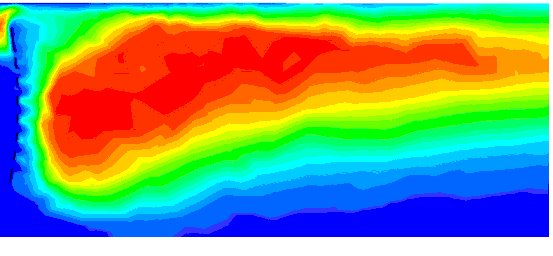
As can be seen from the images, there is less turbulent viscosity occuring in the paddle blade with 25mm holes, therefore it can be concluded that less energy has been put into the water. Turbulent viscosity plots are likely to be good indication of turbulent kinetic energy. The turbulent kinetic energy is related to the amount of energy that has been put into the water.
A few thoughts:
- please understand that my project is not finished, and these are only preliminary results and I have not fully investigated the effects yet
- the CFD analysis only considers the blade in vertical position
- there are a number of other significant simplifications made for practical and time constraints
- holes may have significant effects on the entry and exit motion of the blade
- more in depth CFD analysis would give a better idea of the effects
- more work could be carried out on optimal hole size and configuration
- I am looking into patents, and will hopefully have it sorted early in the new year
- in the end, if this design works, I would like it to be accessible to everyone, so that they could take their cordless drill and modify their paddle to make it more efficient, however, regarding business, if anyone is going to make any money from it, I would like it to be me, hence why I am sorting out a patent
I would greatly appreciate your thoughts and advice on anything you think you can help with.
Subscribe to:
Posts (Atom)

